top of page

Human Risk Beyond the Workplace

Modern organisations face material risk that no longer sits neatly within physical premises, defined working hours, or direct managerial control. Increasingly, operational reliability, safety, conduct, and reputation are shaped by human conditions and pressures that originate beyond the workplace.

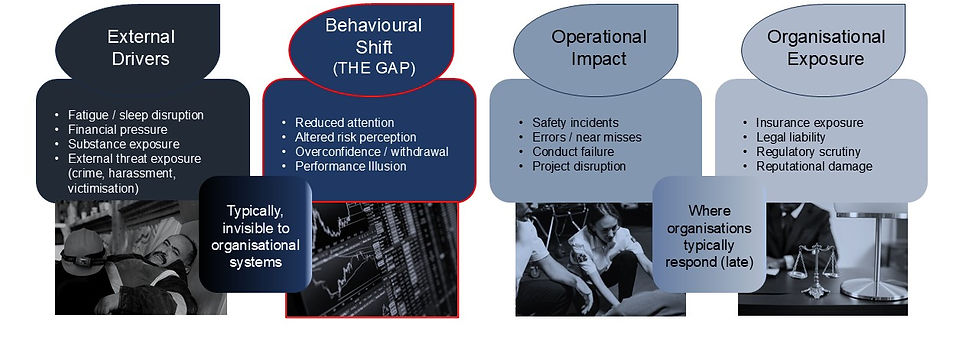
Factors such as fatigue, stress, sleep disruption, financial pressure, medication use, substance exposure, cumulative cognitive load, and situational vulnerability can materially affect judgement, reaction time, attention, and decision-making. These pressures often arise outside the workplace, including through exposure to external threat environments such as crime, harassment, or victimisation, or the anticipation of such risks. Their consequences frequently surface within organisational systems, through incidents, errors, service disruption, conduct failures, regulatory scrutiny, or unplanned absence related to health and recovery.

Across safety-critical and regulated sectors, such human-origin risks are often addressed in fragmented or informal ways, leaving gaps in consistency, assurance, and evidential defensibility. Human Risk Beyond the Workplace frames these conditions not as personal or wellbeing issues, but as predictable risk modifiers that interact with organisational controls.

The framework presented here translates off-site human risk into structured, defensible organisational controls, and is designed to be applied across multiple industries. Sector-specific pages illustrate how the same architecture adapts to different operational, regulatory, and cultural contexts.

The critical insight behind this framework is directional.

Conventional risk thinking asks what threats exist inside an organisation, the disgruntled employee, the compromised system, the conduct failure waiting to happen. DSRM's framework asks a prior question: what vulnerabilities do individuals carry into the organisation from outside, and under what conditions does the organisational environment activate, amplify, or accelerate those vulnerabilities toward an incident?

This distinction matters because the most consequential human risk events, suicide, insider damage, serious conduct failure, reputational harm, are rarely produced by the workplace alone. They are produced by the intersection of pre-existing personal vulnerability with an organisational environment that cannot see it, has no mechanism to surface it, and no structured response when it begins to move.

Identifying that intersection, before it becomes an incident, is what this framework is designed to do.

Human Risk Beyond the Workplace — Risk Translation Pathway

RM-FLOW-2.jpg
Rush Hour

A Cross-Sector Risk Architecture

Insider threats are not a sector-specific risk. They emerge wherever access, motive, and opportunity intersect, though the dominant pressures vary by environment.

These human-origin risk patterns recur across multiple sectors, but manifest differently depending on operational context, regulatory environment, and consequence profile.

​Each sector page illustrates how the same underlying human-risk architecture is adapted to sector-specific operational, regulatory, and cultural conditions.

This framework was not constructed theoretically. It emerged from investigation, across multiple fields and jurisdictions, in which the same structural pattern recurred: a personal vulnerability, invisible to the organisations involved, moving toward an incident that existing risk systems were not positioned to anticipate.

The signals were present in each case. The frameworks to read them were not.

What DSRM provides is the analytical capability to close that gap, not through generic awareness programmes or compliance-driven checklists, but through structured, evidence-led assessment of where external vulnerability and organisational environment are already intersecting in your specific operational context.

© 2026 by DSRM

  • Linkedin
  • Facebook
© Copyright
bottom of page