

Human Risk Beyond the Workplace
Operational risk is no longer contained within the workplace.
Performance, safety, and decision-making are increasingly shaped by conditions that originate outside organisational control — including fatigue, financial pressure, substance exposure, and external threat environments such as crime or victimisation.
These factors do not typically present as visible issues. Individuals may appear capable and engaged, while underlying conditions degrade judgement, attention, and risk perception.
This creates a critical gap between observed performance and actual reliability.
Most organisational systems are designed to respond once that gap has already resulted in an incident — through safety events, conduct failures, or operational disruption.
1. Human Risk
The pathway from external condition to organisational risk is structured and predictable:
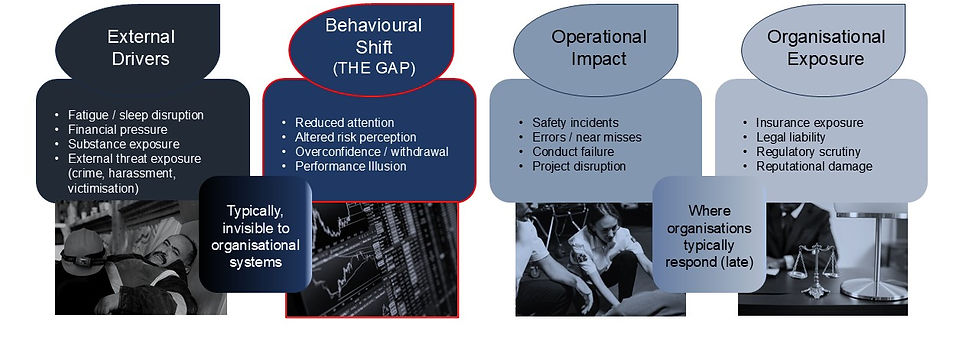
The movement of external risk into operational decision-making
-
Risk develops before it becomes visible.
-
The early stages sit outside traditional organisational controls.
A critical challenge is that this transition is rarely visible in practice:

-
Individuals may appear capable and productive, while underlying conditions degrade reliability.
-
This gap between appearance and reality is where exposure begins.
DSRM addresses this gap directly:

How this model operates in practice
A Different Starting Point
Rather than asking what risks exist inside the organisation, the focus is placed on:
What individuals bring into the organisation, and how those conditions interact with the operating environment
Risk is not created by the workplace alone. It emerges at the intersection of:
external human vulnerability
behavioural change
operational exposure
This is where early-stage risk exists — and where it is least visible.